

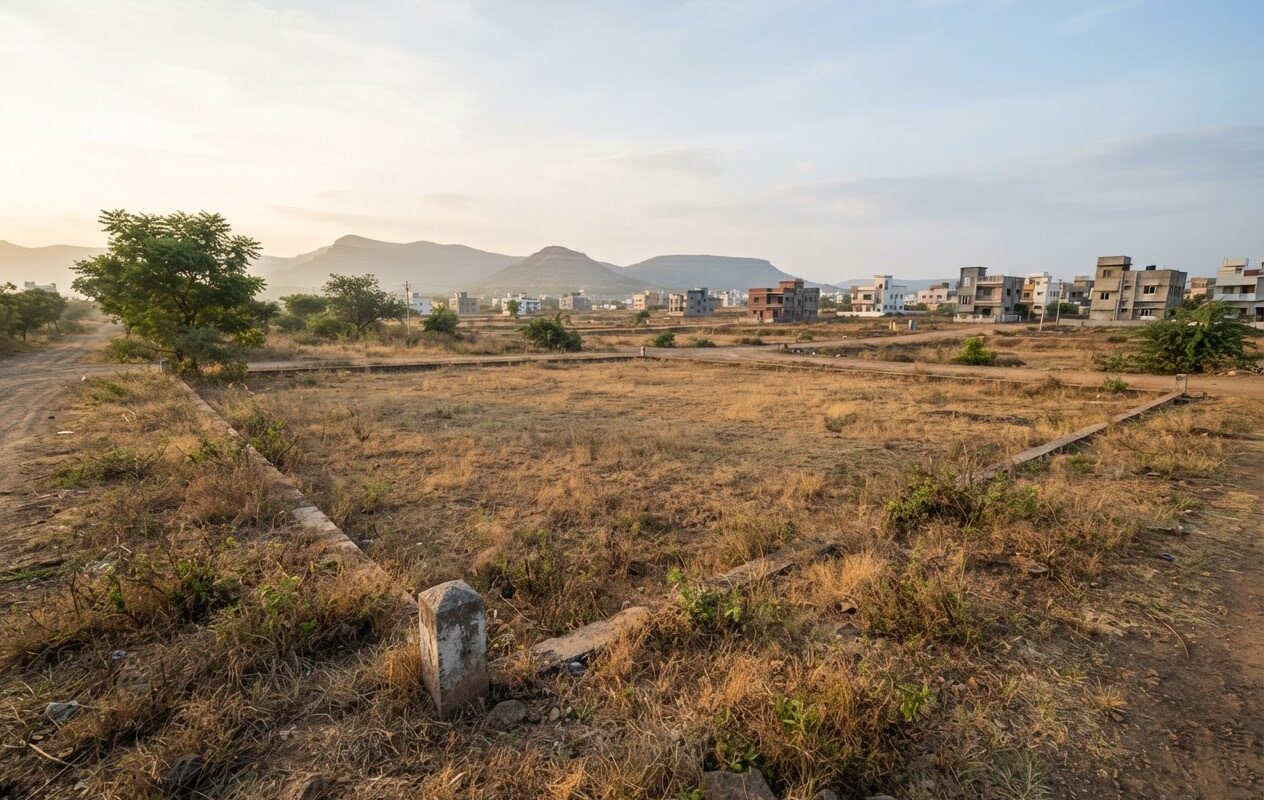
For years, building a house on land that was shown as agricultural in the 7/12 extract meant two separate approvals in Maharashtra: non-agricultural (NA) permission from the Collector’s office, and then building permission from the planning authority. Many plot owners around Pune spent months on the first step before a single drawing was even submitted. That has now changed. Under the Maharashtra Land Revenue Code (Second Amendment) Act, 2025 and the Revenue Department’s implementing order of February 2026, a separate NA permission is no longer needed in most planned areas. This guide explains what changed, what it means for plots under PMC, PCMC and PMRDA, and what you still need to check before you buy or build.
Not sure how the new rules apply to your plot? WhatsApp us your plot location and 7/12 details, and we will tell you which approvals your project is likely to need.
What changed in the NA permission rules
The 2025 amendment reworked the parts of the Maharashtra Land Revenue Code that dealt with NA permission and the annual NA assessment. In simple terms, three things changed:
- No separate NA order where the use is already allowed. If your proposed use, such as a residence, is permissible under the sanctioned Development Plan or Regional Plan and its development control regulations, you do not need a separate NA permission from the Collector. The development permission or building plan approval from the planning authority does the job.
- Annual NA tax is abolished. The recurring yearly NA tax has been replaced by a one-time conversion premium.
- One window for the applicant. You apply to the planning authority for building permission, online through BPMS, AutoDCR or the platform notified for your area, and the land-use change is then reflected in the revenue records.
Once building permission is granted, the change is meant to be recorded in the digital 7/12 extract. Where the systems are not yet linked, the planning authority is expected to inform the Tahsildar so the records are updated. Collectors have also been asked to tell banks not to insist on a separate NA certificate for home loans where planning permission has been granted.

What this means for plots under PMC, PCMC and PMRDA
Around Pune, the planning authority depends on where your plot is: Pune Municipal Corporation (PMC) within city limits, Pimpri Chinchwad Municipal Corporation (PCMC) in its area, and PMRDA across much of the wider metropolitan region. Under the new process, your architect prepares the building proposal and submits it to that authority, the premium is worked out and paid before the permission is issued, and the building permission then covers the land-use side as well.
For a plot owner, the practical benefit is fewer separate offices to deal with. The flip side is that the building proposal itself now carries more weight: if the zoning, access road, margins or ownership papers have a problem, it will surface in the building permission file rather than in a separate NA file. Getting the feasibility check right before submission matters more than ever.
Earlier process vs the new process
| Item | Earlier | Now (planned areas) |
|---|---|---|
| NA permission | Separate order from the Collector or under the deemed-NA provisions | Not needed separately if the use is permissible under the DP or RP; building permission serves the purpose |
| Where you apply | Revenue office for NA, then the planning authority for building permission | The planning authority (for example PMC, PCMC or PMRDA) |
| NA tax | Annual NA assessment | Annual tax abolished; one-time conversion premium |
| One-time premium (planning figure) | Not applicable | Reported as 0.10% of ready reckoner value for plots up to 1,000 sq m, 0.25% for 1,001 to 4,000 sq m, and 0.50% above 4,000 sq m |
| 7/12 record | Updated after the NA order | Updated digitally after building permission, or on intimation to the Tahsildar |
| Home loan papers | Banks often asked for the NA order | Banks asked not to insist on a separate NA certificate where planning permission exists |
Land that was already converted to NA
If your land was converted to non-agricultural use earlier, the change affects you too. With the annual NA tax abolished, owners of previously converted land are required to pay the one-time premium at the prescribed rates within one year, and pending annual NA tax up to the reform date is to be waived, subject to the conditions in the rules. The base value used for older conversions depends on when the land was converted, so ask the tahsil office or your consultant to confirm the exact amount and deadline for your survey number.
If you are buying a plot that was converted years ago, add this to your checklist: ask the seller whether the one-time premium has been paid, and keep the receipt with the sale papers.
What has not changed
- Zoning still decides. The relief applies only where the use you want is permissible under the sanctioned Development Plan or Regional Plan. A plot in a zone that does not allow your use will not become buildable through this change.
- Class II and restricted-tenure land. Building permission does not by itself convert Class II occupancy land into Class I. Where the tenure needs sanction or a premium (nazrana), that still has to be obtained from the competent authority.
- Building rules still apply. Margins, FSI, access road, height and other requirements under the Unified Development Control and Promotion Regulations (UDCPR) are unchanged by this amendment.
- Title still matters. Clear ownership, correct mutation entries and a matching survey or measurement remain the base of every building permission file.
Areas without a sanctioned plan or planning authority, and gaothan land, may follow different procedures. If your plot falls in such an area, confirm the current process with the tahsil office before you plan.
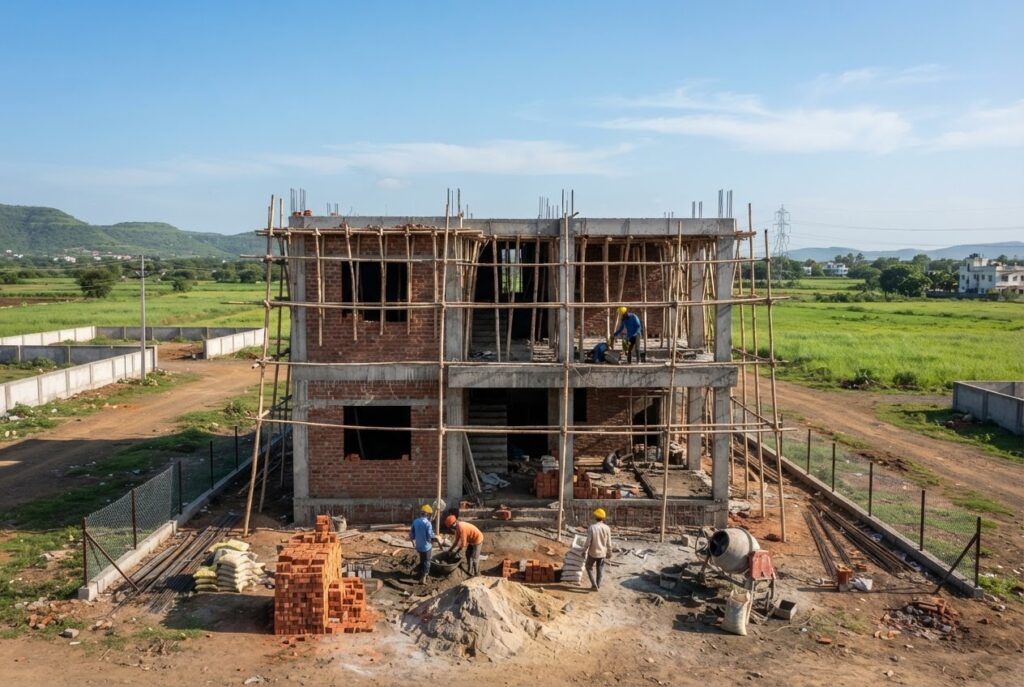
A simple checklist before you buy or build
- Check the plot’s zone in the sanctioned Development Plan or Regional Plan, and confirm your intended use is allowed.
- Read the latest 7/12 extract and mutation entries for ownership, tenure class and any restrictions.
- Confirm legal access: the width and status of the road the plot opens onto.
- For land converted earlier, ask whether the one-time premium has been paid.
- Have an architect check UDCPR feasibility: margins, FSI and what can realistically be built.
- Only then finalise the design and apply for building permission with the planning authority.
How SB Square Projects can help
SB Square Projects LLP has been working on architecture, building permissions, interiors and turnkey construction in Pune since 1995. We can review your plot papers and zoning, check what you can build under UDCPR, prepare the drawings and coordinate the building permission application, and then take the project through to construction. Book a free site visit and estimate, and we will tell you where your plot stands before you spend on design.
Next step: WhatsApp us your plot location and 7/12 details, or explore our bungalow architect services and turnkey construction in Pune. For PCMC plots, see our liaison architect for PCMC building permission service.
Frequently asked questions
Do I still need NA permission to build a house near Pune?
Not as a separate step, if your plot is in an area with a sanctioned Development Plan or Regional Plan and a residence is a permissible use there. You apply for building permission to the planning authority, pay the one-time premium, and that permission covers the land-use change. Check the zoning and tenure of your plot first.
Will my bank accept a plot without an NA order?
Collectors have been asked to inform banks that a separate NA certificate should not be demanded where building permission has been granted. Keep the sanctioned plans, the premium payment receipt and clear title papers ready, as the bank will still check these.
Does this apply to Class II land?
Building permission alone does not change Class II occupancy into Class I. Any sanction or premium required for that tenure still has to be obtained from the competent authority, so check the 7/12 extract before you buy.
Related reading: building permission documents checklist for PMC, PCMC and PMRDA, farmhouse construction near Pune, and authority guides for PMC, PCMC and PMRDA building permission.
Related: PMRDA layout approval: what to check before buying a plot
Sources: Maharashtra Land Revenue Code (Second Amendment) Bill, 2025 (L.A. Bill XCVII of 2025); reports on the February 2026 Revenue Department order by Free Press Journal and Law Web. Rules, premium rates and procedures change; check the latest requirements for your plot with the planning authority and tahsil office.